I was admiring the flood of orbital pictures that are flowing back from the Mercury Orbiter - MESSENGER. This started me thinking about what astronomers were able to see of the surface in the time of great planetary observation in the 1800's. A search of Google Books turned up some gems from the period. I found an interesting article by G.V. Schiaparelli of the Observatory of Milan entitled "Scenes on the planet Mercury" - May1890, Popular Science.
I also found some drawings representing surface features by Percival Lowell in the 1897 Monthly Notices of the Royal Astronomical Society (Vol. LVII).
Imagine what these painstaking observers, that spent hundreds of nights recording dancing visions of this far world would think if they were able to examine the digital images available to us today. Ah for a time machine!
Clear Sky - Rich
Friday
Sunday
March 26, 2011 #124 - Walking the Lunar Surface Again
Last night I was walking around on the lunar surface again. I was having fun looking at the LROC Zoom NAC M113168034R to locate the natural lunar bridge formed by a collapsed lava tube, which left an unbroken span still in place. This formed a bridge over what was once a flowing river of melted lunar crust. In the search through the zoom for the feature I noticed something interesting in a crater near the photos top. Attached are some screen captures. One showing the overall location, so that the crater can be found. I marked on a second copy the point of interest, and the third a 200% enlargement. The curved shadow is what caught my eye as it seems to point to an above surface projection extending from an apparent square shaped base. I understand that to the untrained eye things are not always what they seem, but it is fun to find this in the data. Take a lunar stroll and look for yourself! Hope you have some fun with this and let me know what you think.
Clear Sky - Rich
http://wms.lroc.asu.edu/lroc_browse/view/M113168034R
Clear Sky - Rich
Saturday
March 19, 2011 #123 – East Texas the "Piney Woods"
It amazes me how life plunges on without us being aware. Then "Father Time" smacks you occasionally. I was out admiring the beautiful moon last night as it rose out of a tall east Texas pine and that was one of those reality checks. My mind was recalling the moon rises watched on our journey around America. The native Americans counted time by her monthly passage through the heavens. I find that in our travels I have forsaken the clock and calender and have returned to marking time this way. The days are too short and many pass without registering on our minds. There is trouble recalling what day it is. I remember that in my early youth I lived much like those early Americans with regards to time and now have returned to that place in my mind.
When I look at my blog I see that I have not written an entry in two and a half moons. In that interval we have traveled from "The Panhandle" down through central Texas as far south as San Antonio to live for a time in the "Hill Country", then east to the "Big Thicket". Each region is unique and fascinating to a boy from Indiana. Life is so short and there is so much to see and experience in the natural world we are journeying through. I sometimes feel a sadness at missing things but then an elation at what I have experienced and observed.
A week ago I saw Canopus above the southern horizon. Orion was high in the sky not like I'm accustomed to. As I looked at the star atlas I could see that the Magellanic Clouds were just bellow the horizon. How I would love to see those misty apparitions!
The world news has been very sad for a while, but I still find things to lift my spirits. In our quest to understand the Universe we have discovered many new worlds revolving around far suns, we have entered orbit around Mercury, we have passed the orbit of Uranus on our journey to explore Pluto, we continue to travel the surface of Mars, and stunning views return from the orbit of Saturn. Many new sights still remain to be seen in the future from probes traveling to far destinations and tonight another full moon will have passed. Our personal travels of discovery also continue.
Clear Sky - Rich
Thursday
January 12, 2011 #122 – Deep in the Heart of Texas
The Ghost of Cactus Jack
Well, after many weeks of traveling down through the Texas Pan Handle and admiring this beautiful desert country we have found the Internet near Austin, TX. I spent many a night under desert skies, listening to the coyotes sing their songs, as meteors, lunar eclipses, and the change from fall to winter constellations drew my eyes and ears. I have found that I love the desert. There is something new to see every day. I feel like I did when I was a young lad. Everything is strange to the senses. It’s like starting a new life, learning the plants, walking without the distractions that occur in the bustling areas of the US. As a wildlife biologist in the mid-west for forty years I am experiencing living creatures that have only existed for me in books. It takes a while to get used to walking, as everything is guarded by spines, thorns, or needles, and does not have any pity on the awkward or careless. I am doing OK now, but had to remove my share and lose some blood for a while.
I have been reading a lot about the paleo-history as we travel. I have become fascinated by the early Native American Peoples of the region and their methods of living in this land. Each plant and animal seems to have been utilized in many ways and it is fun seeing what I have been reading about. I was only dimly aware that great wars were fought over hundreds and thousands of years. Native peoples moved from many places, some as far as Canada and displaced whole nations. It seems that no one was able to hold a particular region over long time spans. The people displaced and those new here then adapting to the new habitats. I just completed reading the book chronicling the journey across this region by Cabez de Vaca in the 1540’s the first Europeans to see much of this land and live with the pre-horse native people. Another interesting book was Geronimo's Autobiography dictated at the end of the 1800's. (Both freely available on Google Books) He gives us a glimpse into growing up in the Apache Culture of the region. There is much more to see and learn. I will write as the opportunity's arise but this blog will probably be sparse for a while.
Clear Skies - Rich
Friday
November 19, 2010 #121 – Visit to a New Mexico Cinder Cone.
We visited the Capulin Volcano National Monument today. This cone shaped mountain has many analogs in the solar system. We saw collapsed lava tubes, lava flows, and lava cliffs with strata. In fact I was reminded a lot of the pictures of mars being transmitted by the rovers over the last few years. The lava is the same color and texture. The main difference of coarse is the vegetative cover.
As I stood on the crater rim at 8100 ft. I could see 50 miles across the plains. All along the rift were volcanoes in a line. The lava flow patterns were easy to identify even after 10's of thousands of years.
As I looked east, the almost full moon was rising into the pale blue sky. As I watched, it occurred to me that we are much more fortunate than Martians would have been. Our spectacular satellite is a wonder to behold, and I think what events she has shown upon. Imagine the fire fountains spraying thousands of feet into the sky, building the cone, rivers and pools of lava, with her hanging over the scene in the night. Lighting would play in the clouds of ash and the moons light would cast wandering shadows over all. Then I wonder was any man here to take this all in. Just 8 miles to the north east is the Folsom Site where early artifacts dating around 10,000 years have been excavated. I wonder how long before this were humans in the area. I went to where they would have stood and looked back towards the mountain.
Clear Sky - Rich
As I stood on the crater rim at 8100 ft. I could see 50 miles across the plains. All along the rift were volcanoes in a line. The lava flow patterns were easy to identify even after 10's of thousands of years.
As I looked east, the almost full moon was rising into the pale blue sky. As I watched, it occurred to me that we are much more fortunate than Martians would have been. Our spectacular satellite is a wonder to behold, and I think what events she has shown upon. Imagine the fire fountains spraying thousands of feet into the sky, building the cone, rivers and pools of lava, with her hanging over the scene in the night. Lighting would play in the clouds of ash and the moons light would cast wandering shadows over all. Then I wonder was any man here to take this all in. Just 8 miles to the north east is the Folsom Site where early artifacts dating around 10,000 years have been excavated. I wonder how long before this were humans in the area. I went to where they would have stood and looked back towards the mountain.
(Click to enlarge)
(A line of cones along the rift)
(Inside the cone)
(50 miles east more cinder cones)
(Capulin Volcano)
Clear Sky - Rich
Thursday
November 18, 2010 #120 – Piazzi’s Life and Scientific Accomplishments
After my posts on the discovery of Ceres Ferdinandea I began to wonder about the life of the discoverer. Joseph Piazzi was born in Italy in 1746 and lived to 80. During his early years he became a monk. He taught philosophy and due to some of his teachings alarmed the Dominicans and earned enemies. As a consequence he became a professor of mathematics and was instrumental in reforming the teaching methods of the time in his society.
He was able to persuade the nobility of Sicily to help him establish an observatory at Palermo, engaging Ramsden to construct the instruments which Piazzi designed to improve observational accuracy. The observatory was completed around the end of the century and he began a program of observation. Piazzi conducted exacting observations and rechecked his observations extensively to insure accuracy. His first work was a great catalog of almost 6750 stars and the discovery of the new planet. In his lifetime he recorded over 125,000 observations and ended up with his catalog reaching 7646 stars, an amazing accomplishment.
If you would check the following link you will find a paper written on Pazzi's work with a picture taken from a portrait painting and the transit he had constructed and used to acquire his data.
http://www.lpi.usra.edu/books/AsteroidsIII/pdf/3027.pdf
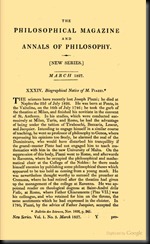
I have included his obituary, which covers his life in more detail, for you to read if you would like to know more. I found it in the 1827, “New and United Series of the Philosophical Magazine or Annals of Philosophy –Vol.I” on Google Books. (Click to Enlarge)


His 1814 Star Catalog is available with the introduction in Latin on Google Books. Look for "Praecipuarum Stellarum Inerrantium Positones Mediae" You can translate the Latin by opening the text version and copying it to a translator such as Google Translate. The tables are readable without translation. I have included the title page and the 1st. page of the Catalog to give you a sample of his work. It is interesting to compare his recorded positions with the current position on a modern computer astronomical chart to see the amount of change that has occurred since the early 1800's.
Clear Sky - Rich
He was able to persuade the nobility of Sicily to help him establish an observatory at Palermo, engaging Ramsden to construct the instruments which Piazzi designed to improve observational accuracy. The observatory was completed around the end of the century and he began a program of observation. Piazzi conducted exacting observations and rechecked his observations extensively to insure accuracy. His first work was a great catalog of almost 6750 stars and the discovery of the new planet. In his lifetime he recorded over 125,000 observations and ended up with his catalog reaching 7646 stars, an amazing accomplishment.
If you would check the following link you will find a paper written on Pazzi's work with a picture taken from a portrait painting and the transit he had constructed and used to acquire his data.
http://www.lpi.usra.edu/books/AsteroidsIII/pdf/3027.pdf
I have included his obituary, which covers his life in more detail, for you to read if you would like to know more. I found it in the 1827, “New and United Series of the Philosophical Magazine or Annals of Philosophy –Vol.I” on Google Books. (Click to Enlarge)
His 1814 Star Catalog is available with the introduction in Latin on Google Books. Look for "Praecipuarum Stellarum Inerrantium Positones Mediae" You can translate the Latin by opening the text version and copying it to a translator such as Google Translate. The tables are readable without translation. I have included the title page and the 1st. page of the Catalog to give you a sample of his work. It is interesting to compare his recorded positions with the current position on a modern computer astronomical chart to see the amount of change that has occurred since the early 1800's.
Clear Sky - Rich
Wednesday
November 17, 2010 #119 – Old Magazine and Journal Illustrations with Astronomical Themes
Tuesday
November 16, 2010 #118 – Observations of Newly Discovered Ceres and Pallas by William Herschel
William Herschel began systematic observations of Piazzi’s Ceres Ferdinandea and Dr. Olber’s Pallas in early 1802. Herschel had constructed some of the best optical systems in existence at the time. These he used to characterize the new planets. This included observing the orbs for color and visible characteristics, searching for moons, and determining the size with as much accuracy as possible.
These observations were published in the 1802, “Philosophical Transactions of the Royal Society of London – Part II” In the same year he also released a catalog of “500 New Nebula” that he had discovered. If you have a chance to read about his life and accomplishments you will be absolutely amazed. The man lived for telescope time and the grinding of giant mirrors with legendary figure!
The following is a bit long but it gives you a sense of his observational and scientific skills. You can find this and the paper presenting the new nebulas on Google Books. (Click to Enlarge)


Clear Sky - Rich
These observations were published in the 1802, “Philosophical Transactions of the Royal Society of London – Part II” In the same year he also released a catalog of “500 New Nebula” that he had discovered. If you have a chance to read about his life and accomplishments you will be absolutely amazed. The man lived for telescope time and the grinding of giant mirrors with legendary figure!
The following is a bit long but it gives you a sense of his observational and scientific skills. You can find this and the paper presenting the new nebulas on Google Books. (Click to Enlarge)
Clear Sky - Rich
Monday
November 15, 2010 #117 - Star-Names and Their Meanings
When I was a boy in the sixties I purchased a copy of Dover’s reprint of “Star-Names and Their Meanings” by Richard H. Allen. This was my first introduction to what the origins for the names of all those places I pointed my telescope at in the night sky.
Today the critics say that the volume is full of inaccuracies, that the author was not conversant in Arabic and many of his sources were incorrect. But, I learned a lot over the years from my much thumbed through copy.
Many times on a search through Google Books, you will hit a book that is an unexpected treat, that was not what you were looking for. Imagine my delight when I found the (1899) first edition scanned and offered for reading. If you would like a copy, go to
http://books.google.com/books?id=5xQuAAAAIAAJ&ots=6qftP3wc78&dq=Star-names%20and%20their%20meanings%20By%20Richard%20Hinckley%20Allen&pg=PR9#v=onepage&q&f=false

If you would like a more modern guide, check into a web site by Gary D. Thompson, of Melton West, Australia. He has gathered a lot of good information. I especially enjoyed looking at his pre-historic sky maps taken from archeological investigations.
http://members.westnet.com.au/Gary-David-Thompson/index1.html
Clear Sky - Rich
Today the critics say that the volume is full of inaccuracies, that the author was not conversant in Arabic and many of his sources were incorrect. But, I learned a lot over the years from my much thumbed through copy.
Many times on a search through Google Books, you will hit a book that is an unexpected treat, that was not what you were looking for. Imagine my delight when I found the (1899) first edition scanned and offered for reading. If you would like a copy, go to
http://books.google.com/books?id=5xQuAAAAIAAJ&ots=6qftP3wc78&dq=Star-names%20and%20their%20meanings%20By%20Richard%20Hinckley%20Allen&pg=PR9#v=onepage&q&f=false
If you would like a more modern guide, check into a web site by Gary D. Thompson, of Melton West, Australia. He has gathered a lot of good information. I especially enjoyed looking at his pre-historic sky maps taken from archeological investigations.
http://members.westnet.com.au/Gary-David-Thompson/index1.html
Clear Sky - Rich
Sunday
November 14, 2010 #116 – Ceres Ferdinandea
While reading the DAWN web site about the 2015 rendezvous with Ceres, I became curious about the discovery of the first minor planet. With a little searching I found that Bode had in 1772, “calculated from his theory of the harmonic ratio of intervals between planets, that such a planet might be discovered” in an orbit between Mars and Jupiter, that we today designate the "Asteroid Belt".
The Italian astronomer Piazzi, of the Observatory at Palermo, using this information, searched and found the moving star on the first day of 1801 in the constellation Taurus. He named the object (Ceres Ferdinandea). Piazzi became ill and the star was lost. Based on Piazzi’s observations, Gauss calculated where it should be and relocated it.

I have included two articles, located from Google Books, which document these events. (Click to Enlarge)


Clear Sky - Rich
The Italian astronomer Piazzi, of the Observatory at Palermo, using this information, searched and found the moving star on the first day of 1801 in the constellation Taurus. He named the object (Ceres Ferdinandea). Piazzi became ill and the star was lost. Based on Piazzi’s observations, Gauss calculated where it should be and relocated it.
I have included two articles, located from Google Books, which document these events. (Click to Enlarge)
(The Monthly Mirror, Vol. XIII – 1802)
(The Philosophical Magazine Vol. XV – 1803)
Clear Sky - Rich
Subscribe to:
Posts (Atom)