Tuesday

October 19, 2010 #090 - Barlow's Fluid Lenses

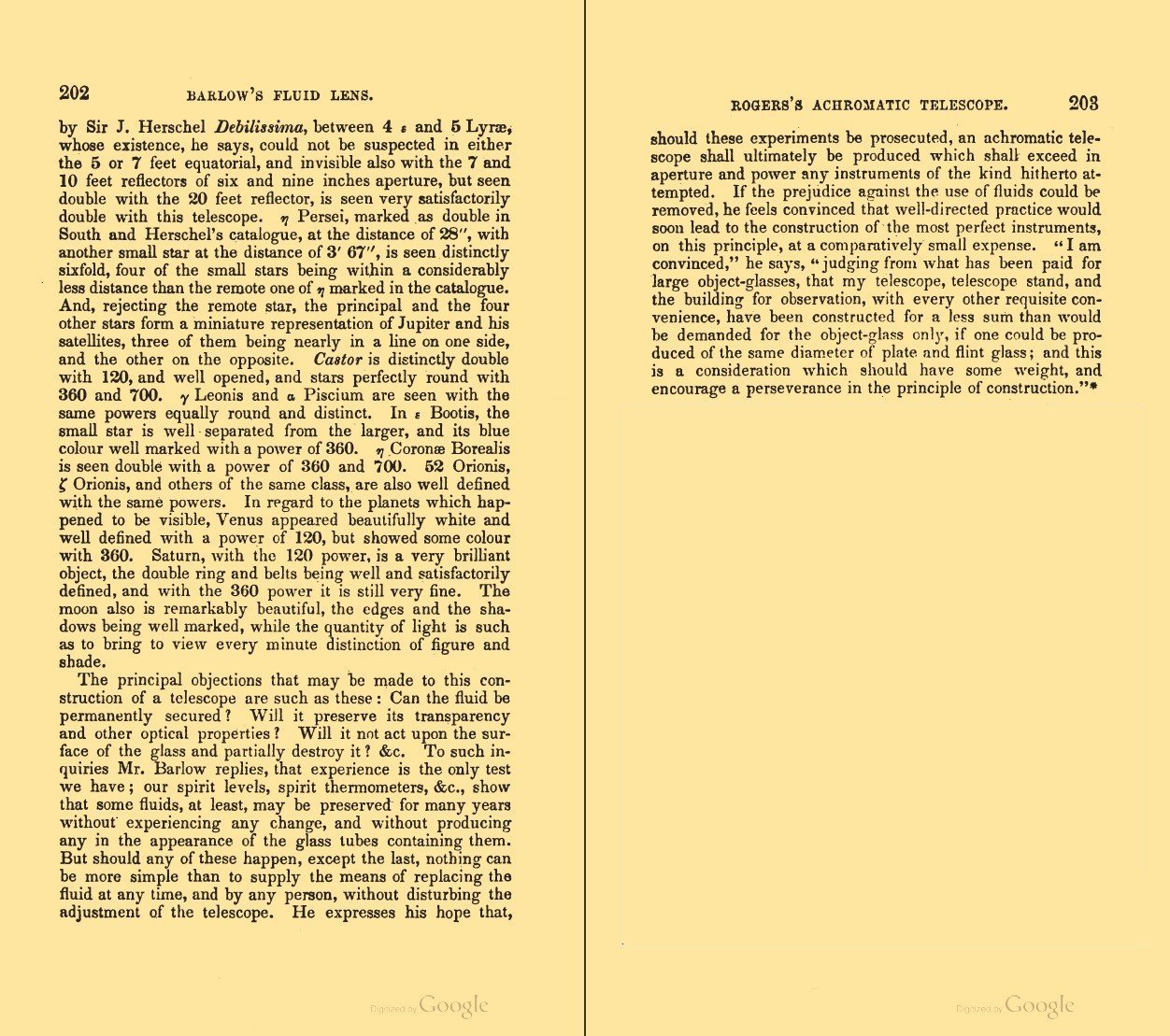
Over the years I have seen a few references to lens constructed of liquids. For instance opticians and experimenters have tried various methods of using "quick-silver" or mercury to form concave mirrors to be used in reflecting telescopes. I've even seen references to the use of ice, in attempts to produce suitable mirrors and lenses. Everything I have read about has major drawbacks.


While searching the index of "The Practical Astronomer" an 1850 book by Thomas Dick marked Vol. IX, I came across an article about Dr. Barlows experiments with fluid lenses and his success in constructing very high quality astronomical telescopes. Dr. Peter Barlow was the inventor of the Barlow Lens, used widely in optical instruments. The short article has a wealth of information on what materials he used and his designs, along with observations he made to test the optical properties of the instruments. A preserved piece of astronomical history that took place over 160 years ago.

(Click on picture to enlarge for reading)


Clear Sky - Rich

Monday

October 18, 2010 #089 - Satellite of Venus

One of the historical, observational anomalies, that has fascinated me since I was a young lad is the sighting of a moon orbiting Venus. We know now that there is no such beast, but that was not always true. This debate continued through the 18th and 19th centuries. In my recent searches through Google Books, I have turned up an in depth article in one of the most prestigious scientific journals - "Nature". Granted this is in the June 19, and July 7, 1876 issue, but from reading this information it strikes me that this publication has never lowered it's standards. The article is by none other than T.W. Webb, well known from his Observational Guides, still popular today. I gained a lot of enjoyable history from this paper and I hope you will enjoy reading it.

(Click on the individual page to enlarge it for reading)


Clear Sky - Rich

Sunday

October 17, 2010 #088 - Spokes on Saturn's Rings in 1888

NASA

As I was reading a Google scan of the February, 1888 - "The Journal of the Liverpool Astronomical Society", I was surprised when I looked at Plate XII (Figure 14 & 19). It is a drawing by a Society member, Thomas Gwyn Elger, of Saturn's Rings. What was striking about his drawings was an apparent record of "spokes" on the Rings. If memory serves me, I have read that these ghost like markings were discovered during the Voyager Mission as it scanned Saturn at the end of the 20th. century and more recently by the Cassini Mission. It appears to me that Mr. Elger may have got a jump on us by about a hundred years!

With a little Wiki research I found that Mr. Elger was a lunar mapper who had an observatory with an 8.5 inch refractor in Bedford, England. He was the first director of the Lunar Section of the British Astronomical Association and was a member of several other Astronomical Societies. His 1895 book - "The Moon: A Full description and Map of its Principal Physical Features" is highly regarded due to it's maps. (Available on Google Books) His sketches from 1884 to 1896 are now in the possession of the BAA. He even has a crater on the moon named in his honor.


These drawings and his notes are included for you to take a look at.


Clear Sky - Rich

Saturday

October 16, 2010 #087 - The Canals of Mars


A couple of posts back I mentioned the Canals of Mars. In my Google Books search into astronomy another trio of old gems turned up.

In 1921 the book "Mars" was published containing all the papers of importance written by William H. Pickering between 1890 and 1914. Below is a list of the 17 papers presented in the book. My favorite is "Signalling to Mars".


Two other books, I found, are by Percival Lowell. One is entitled "Mars and Its Canals". This was produced in 1906 and in 1915 "Memoirs of the Lowell Observatory - Memoir of a Trans-Neptunian Planet"


I visited the Lowell Observatory, in Flagstaff, Arizona during the early 1970's. In the late 1890's Lowell built the observatory there and did most of his work with the 24" Alvan Clark refractor. Percival Lowell's mausoleum was located on Mars Hill near the Observatory. I remember the observatory shaped structure with a beautiful blue glass dome, a fitting resting place for an avid astronomer. Hope you enjoy these gems.

Thanks! Google for preserving all these treasures. Without your efforts we would never have the chance to read these.

Clear Sky - Rich

Friday

October 15, 2010 #086 - Lava Tubes on the moon

It is strange how science fiction writers develop story lines which predict, at least to a degree, scientific discoveries years later. When I was a young lad I was an avid reader of this genre. One of my favorite stories was an early book written by Donald A. Wollheim, titled - "One Against the Moon". This was the story of a boy stowing away on the first unmanned rocket to Luna. The craft crashes, he survives in a stolen spacesuit, and finds a habitat in the caves below the surface. This subterranean world was populated by an entire ecosystem of lunar flora and fauna.

Of course, this ecosystem does not exist. But, the earth's robotic lunar exploration satellites have recently discovered that lava tubes do exist below the lunar regolith! There is even some talk, in scientific circles, about building viable bases in these tubes in the future. "Wow!", the boy in me says. Maybe, Robert A. Heinlein's - "The Moon is a Harsh Mistress" might come true!


The Japanese Lunar Space Craft Selene/Kaguya discovered this opening.
Credit: NASA/Goddard/Arizona State University


Credit: NASA/Goddard/Arizona State University

One final thought. Recently water has been discovered on Luna! For years I have read that not one drop could be found there. The master of scientific prediction, Arthur C. Clarke, wrote a line in "The Sentinel", in 1951, which still gives a thrill to my little boys heart.

"... some thousand million years before. When life was beginning on Earth, it was already dying here. The waters were retreating down the flanks of those stupendous cliff s, retreating into the empty heart of the Moon. Over the land which we were crossing, the tideless ocean had once been half a mile deep, and now the only trace of moisture was the hoarfrost one could sometimes find in caves which the searing sunlight never penetrated."

Is it such a leap to imagination that some future lunar probe or even a team of sub lunarian explorers will discover a living patch of mat like bacteria deep below the surface in some dark lunar passageway.

Clear Sky - Rich

Thursday

October 14, 2010 #085 - The Planet Vulcan

In my last post I wrote about an 1800's Amateur Astronomical publication that I have been reading on Google Books. Here is an article that I dredged up about the Planet Vulcan, supposed to be located between Mercury and the Sun! It was published at the turn of the century (Circa 1900) in The Chicago Times and also the Rochester Democrat. It is interesting that more than one scientist was convinced of the observations and their verification. I am reminded of the canals of mars of which many drawings and maps were produced. Enjoy this little piece of astronomical history, sort of the Supermarket Tabloid story of the time. (Click to enlarge)


Clear Sky - Rich

Wednesday

October 13, 2010 #084 - The Astronomical Register


Over the past year I have been reading Astronomical Literature on Google Books. If you like to read old periodicals on astronomy then this is a treasure trove waiting to be discovered. One of the first series I downloaded was "The Astronomical Register". It started publication in 1863 as "A medium of communication for Amateur Observers, and all others interested in the science of Astronomy". I found all Volumes published from 1863 through 1886. (listed below to aide in your search) It is interesting to see how things have changed and how they have remain unchanged for almost 150 years. I am finding a lot of observational gems as I go through the volumes and possibly you will too.


Clear Sky - Rich

Tuesday

October 12, 2010 #083 - An interesting sky effect.


My wife and I were on the shore of Lake Superior in September. It was an exceptionally fine day. Warm air and shallow water, warm enough to swim for hours giving us a wonderful day! This warmth only extends out to a depth of a few feet, cold water always lurks below Superiors surface. As a consequence a layer of fog hovers over those deeper waters in a layer, even when the sky is clear and sunny.

You can see this in the picture above. (Click to Enlarge) This photo was taken towards the north where Canada sits about twenty miles away. On Canada's shore and extending inland for several miles, is a hilly area where a giant wind farm has been constructed. The result is that you can see the lake surface, a bank of fog hiding Canada, and the immense wind generators floating on the "Clouds". To me it looks as if a city far away has been built on the clouds.


Clear Sky - Rich

Monday

October 11, 2010 #082 - The Dog that Watches the Sky.


This is our traveling companion Ruby, an English Springer Spaniel. When she was a pup I amused her by moving a laser pointer all over the house for her to chase. Great fun but with lasting consequences. It seems that three years later she has a fondness for solar reflections and the moon. It is amazing but she has figured out that a combination of the sun and reflective objects produce moving sun beams. I have watched her move objects to cause the reflections to move then rushes to follow them. It is an action and reaction which she has figured out.

This is not all, she notices and watches objects in the sky. She will watch planes, from jets leaving contrails, to light planes, the flight of soaring hawks and high flying ravens fascinate her. Leaves and wind blown seeds making their way in the wind draw her notice. She also has a fascination with astronomical objects, and here is where I am most amazed. On our evening walks at dusk she will suddenly spot Venus or the moon. Some dogs and wolves howl at the moon but Ruby is different. She will pause, look at them, and stand on her hind legs, as if to get a closer look! - She's my little astronomer companion.


Clear Sky - Ruby & Rich

Sunday

October 10, 2010 #081 - Skies of Colorado


We have been set up in almost the exact center of Colorado for the last month. We are presently adjacent to the 12 to 14 thousand foot College Mountain Range at an altitude of about 8,000 ft. To say that the seeing is good, in most places, is not in the same class as high in the mountains. My aging eyes, when dark adapted, can see star clusters that are clearer than I can remember from my boyhood in rural Indiana.

I was out laying in my lawn chair, with my binoculars, watching for meteors a few nights ago. I picked up a few bright ones during the period between 3:30 and 4:30 am. After I would spy one I would quickly try to see the trail in the binoculars with only marginal success. As I caught #7 slightly to the SE of Polaris I quickly centered the trail in view. I was amazed to see the trail lingering. It remained a strait line the color and transparency of cigarette smoke for the first minute and expanding very little. To my amazement during the second and third minute it began to bend into an "S" shape similar to the constellation Draco not far away. In all it was visible about 3.5 minutes. When the excitement began to subside and I had time to think about what I had seen it struck me that this was an illustration of atmospheric currents at probably over 60 miles near the edge of space.

The next night I caught ISS going over and later two identical satellites in near polar orbit about ten degrees apart one right behind the other with exactly the same brightness. Tonight the thin crescent of the moon floats over 14,000 ft. Mt. Princeton. Exciting observations, for a boy from the flat lands of Indiana.


Clear Sky - Rich